The same thread comes back on Bike Forums, TrainerRoad, Cycling UK, 77bike and NGA every few months. A freshly installed TPU tube is down 20 psi overnight. Bad unit, or just how TPU behaves?
Two camps form right away. One blames the material: TPU walls are a fraction of butyl's thickness, permeability is higher, and 20 psi is the price of saving weight, so pump before every ride and move on. The other points at riders who go weeks between top-ups after switching to metal-stem tubes. Both sides are working from anecdotes. Most packaging says "butyl-like air retention" and publishes nothing about resin grade, wall thickness or test conditions, so there is no baseline to argue against.
The short version: On a 700×28c road tire at 80 psi, a 15–20 psi overnight loss cannot come from permeation through intact TPU film. Once temperature and gauge artifacts are ruled out, a drop that size points to a discrete leak. By structure, check the valve interface first, then the weld seam and the rim side.
1. Two different things are getting called "air loss"
Permeation is gas dissolving into the polymer and diffusing across the whole membrane. It is slow, uniform, happens over the entire tube surface, scales inversely with wall thickness, and no amount of valve-core tightening will change it.
A slow leak is bulk flow driven by pressure through one local path: a worn core seal, cracked plastic threads, a delaminated valve base, a pinhole in the weld, or something sharp in the tire casing. It is fast, localized, and findable. Keeping the two separate makes the rest of the math straightforward.
2. What the numbers actually look like
The table below applies Fick's First Law, Q = (P_air · S · Δp) / d, to a standard 700×28c (ETRTO 28-622) road tire, using published 23°C permeability coefficients in cm³·mm/(m²·day·atm). TPU values come from BASF Elastollan datasheets. Air permeability is weighted as 78% N₂ plus 21% O₂.
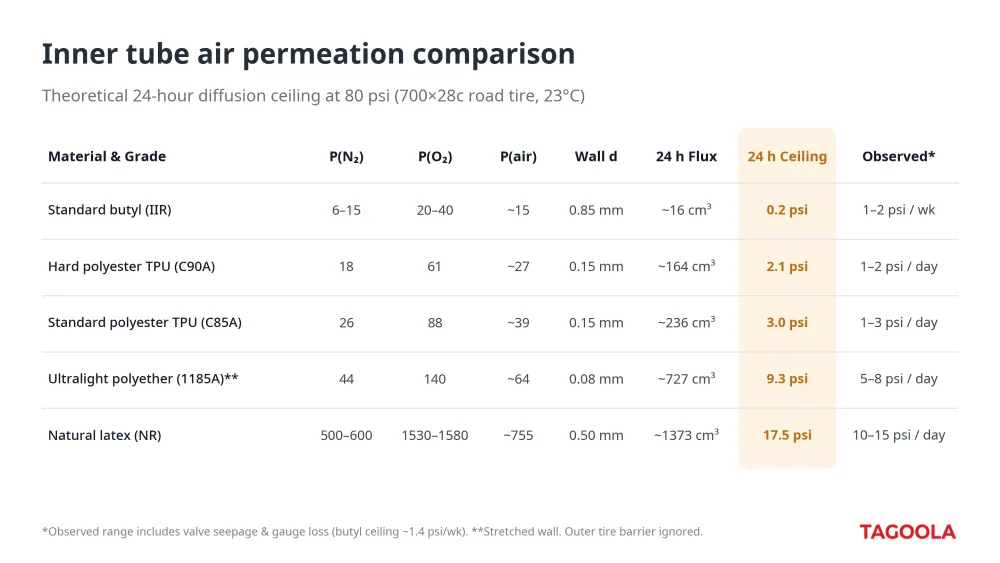
Geometry: a 700×28c tire has an effective inner surface area of about 0.167 m² and an air chamber of about 1,150 cm³ including the rim bed. At 23°C and 1 atm, 1 psi corresponds to roughly 78.2 cm³ of air, and 80 psi gauge is a 5.44 atm pressure difference across the film. The calculation deliberately omits the secondary barrier of the tire's rubber and casing, so these figures sit at the upper limit for pure membrane permeation.
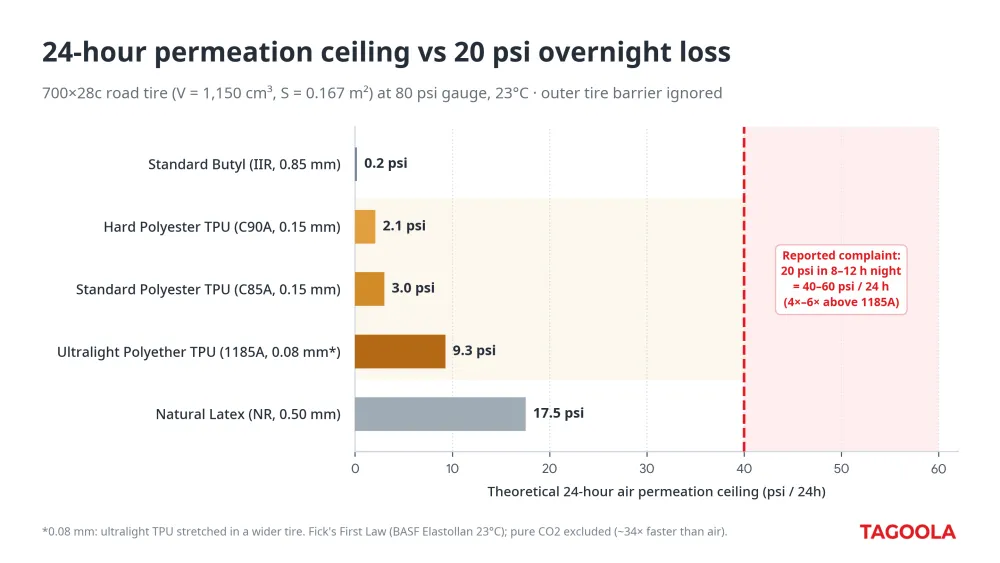
What 20 psi means in volume. Losing 20 psi from a 700×28c tire means roughly 1,565 cm³ of air (at 23°C, 1 atm) escaping.
Where the ceiling sits. Even the higher-permeability polyether grade (1185A), stretched to 0.08 mm with no tire barrier at all, tops out at 9.3 psi/24h. That is the fastest TPU film in the table.
The time base has to match. Treat "overnight" as 8 to 12 hours and 20 psi converts to an initial loss rate of 40 to 60 psi/24h, or 4 to 6 times the 1185A ceiling. Membrane diffusion simply does not reach that order of magnitude.
Why two TPU tubes feel nothing alike. The 0.15 mm and 0.08 mm walls differ by 1.9× on their own. Polyester and polyether resin differ by another 1.4× to 2.4×. Multiply those together and you land between 2.5× and 4.5×. Forcing a tube rated to 28c into a 32c tire adds a smaller bump: on torus geometry, walls thin by about 13% and surface area grows 15%, for roughly 30% more flux.
The one genuine permeation exception is CO2. On the same Elastollan C85A sheet, CO2 permeability is 1,313, about 50× nitrogen and 34× air. Because pressure drops as CO2 escapes, the loss follows exponential decay (τ ≈ 19 h for 0.15 mm C85A): from an 80 psi fill, an 8 to 12 hour night costs roughly 28–38 psi, rather than 34 multiplied linearly across 24 hours. Whether adiabatic cooling from a cartridge harms the valve base bond is something we have not measured; purging and refilling with air the same day is the safe habit.
3. The bottleneck is at the valve
A butyl tube is vulcanized onto a brass stem, which gives you a near-seamless chemical bond. Thermoplastic TPU cannot be vulcanized that way, so the stem has to be bonded, overmolded or mechanically clamped onto thin film. Nearly all recent product development has focused on that joint, and nobody claims to have invented a non-permeating plastic.
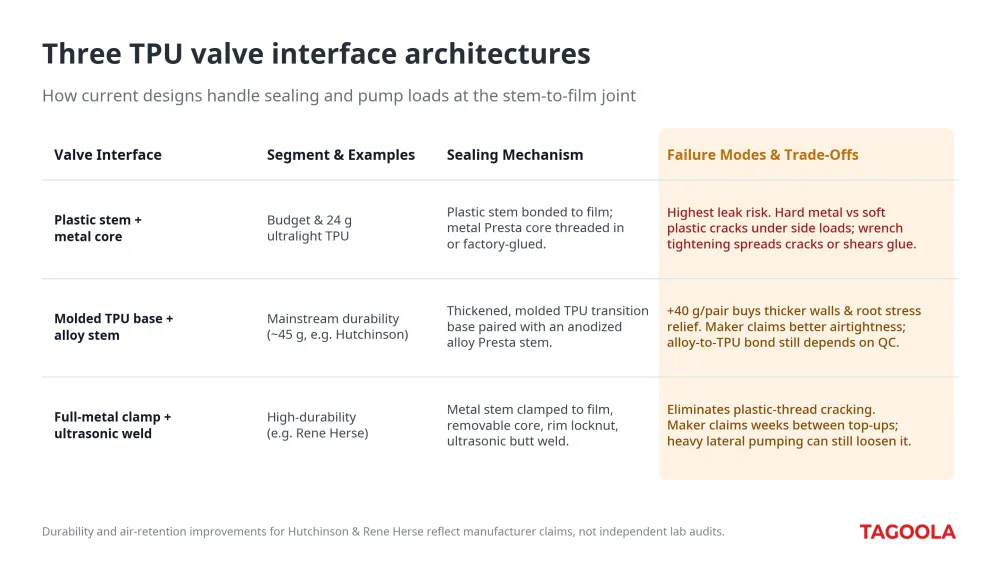
One boundary worth stating: the durability and retention improvements attributed to Hutchinson and Rene Herse above are manufacturer claims and press coverage, not a multi-sample audit we ran. Together they still point to the same industry priority: fixing the valve interface.
Two leak paths sit outside the valve. First, the ring butt weld, where thermal or ultrasonic weld lines can carry microscopic pinholes, plus crease fatigue in very thin budget batches. Second, damage from the rim and tire side: TPU walls run 1/6 to 1/11 of butyl's thickness (0.15 mm down to 0.08 mm against 0.85 mm), leaving far less margin against local shear. Rim tape that has shifted to expose a spoke hole edge, a burr around the valve hole, or a chip of glass embedded in the casing will often leave thick butyl alone and punch a pinhole straight through TPU. Those pinholes can close again at low pressure, which is how they get misdiagnosed as inherent porosity.
4. Some of that loss never left the tube
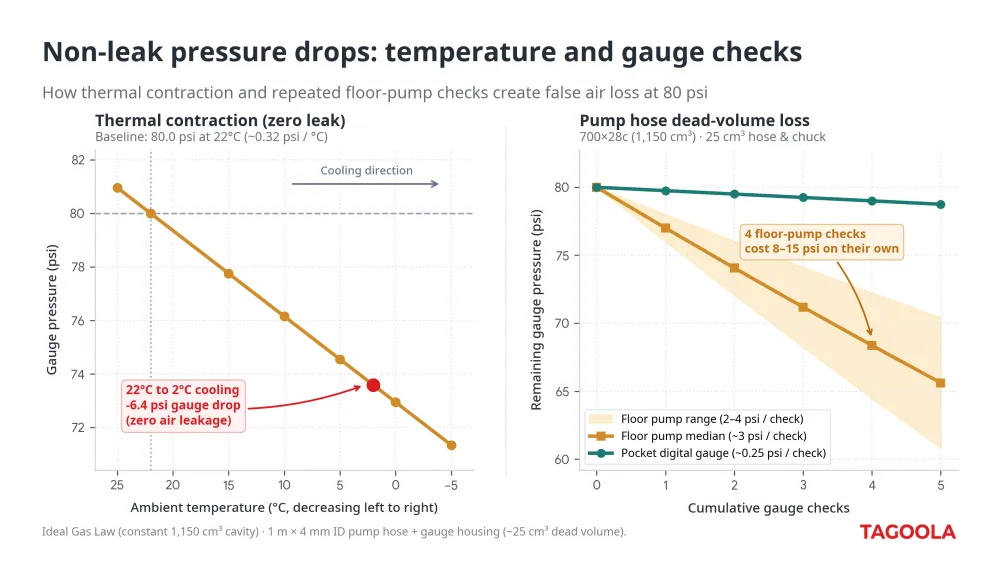
A good share of "I lost 6–10 psi overnight" reports involve no structural defect at all. Three measurement effects regularly stack on top of normal permeation.
Temperature. At near-constant volume, P₁/T₁ = P₂/T₂, using absolute pressure and Kelvin. Inflate to 80.0 psi gauge (94.7 psia) at 22°C (295.15 K), roll the bike into a 2°C (275.15 K) garage, and the gauge reads 73.6 psi the next morning with zero air lost. That is 6.4 psi from a 20°C swing, or about 0.32 psi per °C at 80 psi. Readings taken while the tire is still warm from a ride behave the same way once it cools.
Pump dead volume. A 1 m hose at 4 mm ID holds about 12.6 cm³. Add the gauge chamber and chuck and you have roughly 25 cm³ of unpressurized space. Clamp that onto a 1,150 cm³ road tire at 80 psi and equalizing it costs about 1.7 psi before any air reaches the tube. Add the puff lost on disconnect, especially on smooth threadless plastic stems, and every floor-pump check costs 2–4 psi. Four checks over a few days remove 8–15 psi on their own.
The gauge itself. This one gets skipped more often than the other two. A 5% error on an inexpensive pump head is common, which is ±4 psi at 80 psi. Two gauges that disagree by 7 or 8 psi are not rare. If you want to compare retention seriously, use one gauge for everything.
5. Matching the symptom to the cause
Permeation ceiling, interface failure and measurement loss together cover most real-world cases. Every time figure below is per 24 hours; "overnight" is converted at 8 to 12 hours.
The 15–20 psi figure applies to TPU, as shorthand for roughly two to three times the film ceiling. Natural latex permeates at up to 17.5 psi/24h by design, so losing 20 psi in 24 hours would be close to normal for latex. Always match the benchmark to the tube material you are running.
6. Finding the leak safely
The table tells you a leak exists. Finding it takes a few minutes, and the pressure limit on step two matters.
Step one, with the tire mounted. Keep the tube inside the tire, inflate to normal riding pressure (60–80 psi), and submerge the valve side in a basin or brush concentrated soapy water over the valve. With the tire on, check three spots: the Presta tip, the joint between core and stem, and the rim valve hole (bubbles escaping from the valve hole or spoke holes point to an internal valve-base or casing leak). Give it 1–2 minutes, because slow leaks often release one tiny bubble every 10–20 seconds. Starting here saves you from pulling the tire when the core or stem is the culprit.
Step two, with the tube out. Only if the mounted valve check shows no bubbles do you pull the tube to inspect the valve-base joint, the ring butt weld, and the tube body. Once the tube is out of the casing, it must not be inflated to riding pressure.
Do not inflate a bare TPU tube past 5–8 psi (0.5 bar). With no tire holding it, a TPU tube above roughly 5–8 psi will balloon permanently or burst outright. For a water test, inflate to 3–5 psi—just enough to round it out—then work along the tube in four sections and dunk each one to inspect the valve base, butt weld, and body.
Shake the water out of the valve cavity and dry it before refitting. Trapped water works its way down the stem.
Avoid forcing a core wrench on a plastic stem: on threaded plastic barrels the threads crack easily, turning a minor seal issue into a ruined tube, and on factory-glued non-removable cores you will shear the seal outright.
7. Three things worth checking before you buy
A pair of 24 g ultralights versus 45 g durability-focused TPU tubes differs by a bit over 40 g, which you will not feel on the road. If you want fewer slow leaks over the next six months, check three hardware details before checkout.
Stem material and native length. A full-metal stem resists pump-chuck leverage and matches the hardness of a metal core. Buy the native length that clears your rim depth instead of threading an extender onto a plastic stem.
Whether the core can be replaced. A metal stem with a removable core is the low-maintenance combination: an aged O-ring or grit becomes a two-minute swap. A factory-glued, non-removable plastic core should never see a core tool.
Base reinforcement and a rim locknut. Favor a molded transition base or a clamping disc over a flat glued seam. A locknut stops rattle and also transfers pump push and pull directly into the rim instead of peeling the film around the valve root.
8. What this piece does not measure
The ceilings above are calculated from published BASF Elastollan data and Fick's First Law. They are not an ASTM D1434 film test, and they are not a 30-day multi-sample retention audit of RideNow, Tubolito, Pirelli, Hutchinson or Rene Herse. Manufacturer structural benefits are labeled as claims throughout.
Actual resin blends, additives, stretch ratios and batch QC across retail brands need controlled multi-sample data to map. That is why this breakdown sticks to what the physics supports: permeation cannot produce a 20 psi overnight loss, so inspect the valve and rim side rather than assuming the film is at fault.